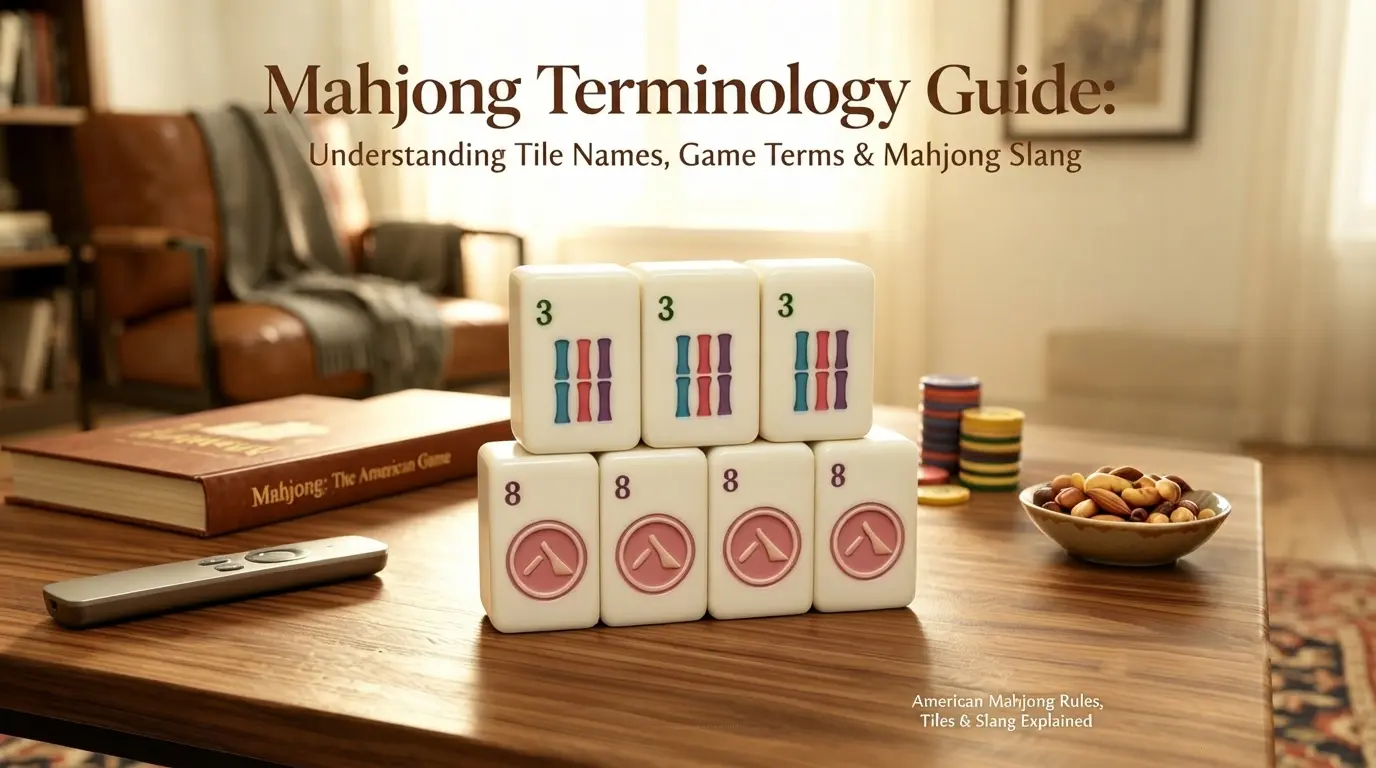
Mahjong Terminology Guide: Understanding Tile Names, Game Terms & Mahjong Slang
If you’ve ever felt lost at an American mahjong table – unsure what “Charleston” means or why everyone keeps shouting “Kong” – you’re not alone. American mahjong comes with its own rich vocabulary, and without a firm grasp of the key Mahjong terminology, even a promising hand can turn into a headache. Whether you’re deciphering your first scoring Card or brushing up on the lingo for a competitive club, this comprehensive Mahjong terminology guide breaks down everything you need: the basic tile names, the essential game terms that drive each round, and the colourful Mahjong slang that makes the game so much fun. By the end, you’ll not only understand the chatter – you’ll be part of it.
1. Tile Names & Essential Accessories
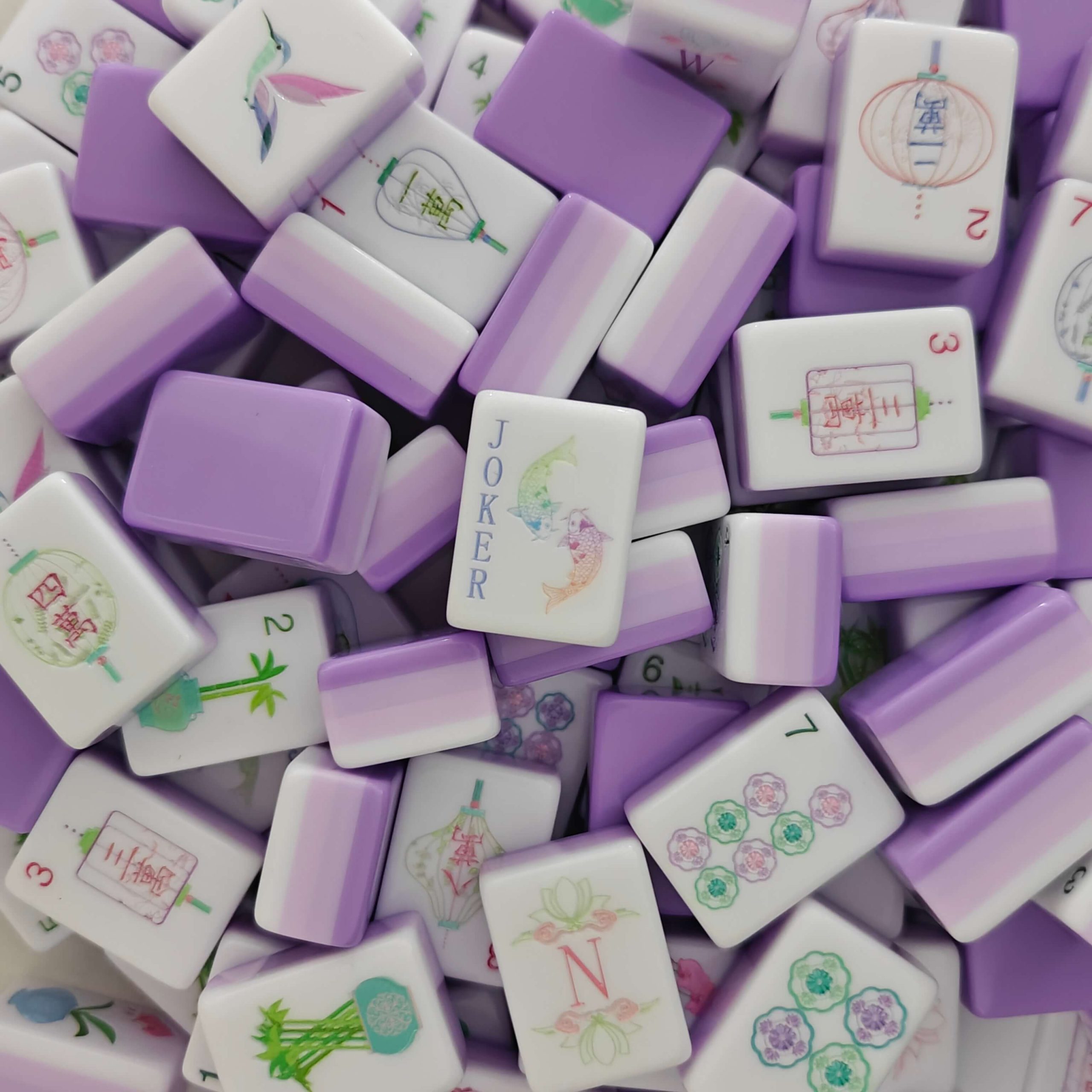
Every game starts with the tiles and the gear. American mahjong uses a 152-tile set, and the three suits are your first milestone:
| Term | Meaning |
| Crack (Crak) | Character suit, showing Chinese numerals (representing “ten thousands”) |
| Bam | Bamboo suit, drawn as green bamboo stalks, numbered 1–9 |
| Dot | Circle suit, looking like coins or dots |
| Joker | Wild tile that can substitute for any other tile (8 in a standard set) |
Beyond the tiles, you’ll need a few essential accessories to play comfortably:
| Accessory | Purpose |
| Card | The current year’s scoring reference; lists all valid winning hands. Every player must have one. |
| Rack | A wooden or plastic tray to hold your tiles upright, keeping your hand organised and visible. |
| Pusher | A long, flat tool to slide tiles across the table smoothly – especially useful during the Charleston. |
| Dice | Used to determine the dealer and break the wall. |
| Wind Indicator | Marks the current prevailing wind and seat winds. |
| Chips | Used for scoring or betting, depending on your group’s style. |
If you’re building your first kit or upgrading an old one, having a complete set with a sturdy rack, a clear Card, and all the extras makes a huge difference. Browse our full collection of mahjong sets and accessories —— from budget friendly starters to premium editions that include dice, wind indicators, rule cards, chips, replacement stickers, and even a canvas carry bag —— so you have everything you need in one box.
2. Game Terms & Core Mechanics
Knowing the tiles is only half the battle. American mahjong has a unique set of actions that define the rhythm of play. Here are the key game terms you’ll hear every round:
| Term | Definition |
| Charleston | Mandatory tile-passing at the start of each hand: pass unwanted tiles right, then left, then across (3 rounds total). |
| Exposure | Showing a completed set (Pung, Kong, etc.) to the table – it makes your progress public. |
| Pung | Three identical tiles. |
| Kong | Four identical tiles. |
| Quint | Five identical tiles – rare, possible because of duplicate tiles and jokers in American sets. |
| Calling a Tile | Declaring that you need a specific tile to complete your hand (often with a verbal shout). |
These terms are your playbook. For example, during the Charleston you might give away a tile that later turns out to be crucial – so knowing the strategy behind each pass is vital. And when you call a tile, you commit to that move, so confidence matters. To practise these moves smoothly, you’ll want reliable equipment.
3. Mahjong Slang & Insider Expressions
Now for the personality of the game – the slang. American mahjong players have developed a lively set of informal expressions that add colour to the table. Here are the most useful ones:
| Slang Term | What It Means |
| Hot Tile | A dangerous tile to discard – it could complete an opponent’s winning hand. |
| Dead Hand | A hand that can no longer win (e.g., after too many passes or an illegal exposure). Play defensively. |
| Garbage Tile | A useless tile you desperately want to get rid of during the Charleston. |
| Sweet Hand | A hand that is very close to winning, often with multiple jokers. |
| Sit – and – Go | An informal game that starts as soon as enough players are seated – no fixed schedule. |
Slang isn’t just for fun – it helps you read the table. When you hear “hot tile,” you hesitate; when someone says “sweet hand,” you tighten your defence. Mastering these expressions makes you feel like a true insider and adds a social layer that keeps players coming back.
4. Why This Terminology Matters
You might ask: do I really need to memorise all this? Absolutely – and here’s why. First, knowing the Mahjong terminology cuts your learning curve dramatically. Instead of stopping every few seconds to ask for translations, you can focus on reading the game and predicting opponents’ moves. Second, it builds confidence. Walking into a new club or sitting with experienced friends becomes far less intimidating when you understand every call, joke, and tactical hint.
Third – and most important – these terms are strategic tools. Understanding what a “quint” is might stop you from discarding a tile that could become a powerful five-of-a-kind. Knowing exposure rules helps you decide when to reveal a set and when to keep it hidden. This Mahjong terminology guide is not a dusty dictionary; it’s a practical cheat sheet that makes you a sharper, more strategic player.
5. Ready to Play? Get Your Gear and Join the Fun
Now that you speak the language of American mahjong, it’s time to put it into action. Gather your friends, set up your table, and let the tiles do the talking. The best way to internalise these terms is to play regularly – each hand teaches you something new, and every mistake is a lesson.
If you’re ready to start or upgrade your set, we have you covered. Our complete mahjong sets include not only the 160 tiles and jokers, but also all the accessories you need: dice, a wind indicator, rule cards, chips, replacement stickers, and a durable canvas bag to carry everything. And for a limited time, we’re running a special promotion – visit our exclusive offer page to claim a discount on your first order. Don’t miss the chance to begin your mahjong journey with a high-quality set that has everything in one box.
Happy mahjonging – and may your hands always be sweet!